
Caracterización de las unidades productoras de Suero Costeño (SourCream) del departamento de Córdoba-Colombia

Palabras clave:
Buenas Prácticas de Manufactura (BPM), Cadena agroindustrial, Caracterización, Suero CosteñoBarra lateral del artículo
Aceptado 2025-09-18
Publicado 2025-11-24
Contenido principal del artículo
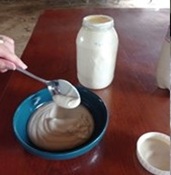
Introducción: el proyecto se llevó a cabo en cuatro regiones agroecológicas de Córdoba, las cuales concentran la mayor producción de leche y elaboración de derivados de este departamento. El Suero Costeño es un producto lácteo fermentado, que se elabora y consume tradicionalmente en la Costa Atlántica colombiana, pero no se dispone de información documentada acerca de las características de las unidades de transformación y de su proceso de elaboración.
Objetivos: el objetivo de la investigación fue la caracterización de las unidades de producción de Suero Costeño del departamento de Córdoba en Colombia.
Metodología: se realizaron encuestas sobre las historias de vida, la actividad productiva y la implementación de las Buenas Prácticas de Manufactura (BPM) en 96 establecimientos productores de Suero Costeño de cuatro (4) regiones agroecológicas de Córdoba (Sinú Medio, Centro, Bajo Sinú y Sabanas).
Resultados: el Suero Costeño lo elaboran artesanalmente pequeños productores, mediante dos procesos de producción, uno que fermenta espontáneamente leche, grasa o ambas, y otro que aprovecha el lactosuero de quesería. La mayoría de las unidades de producción (78,8%) presentan deficientes condiciones higiénicas y fallas en la implementación de las BPM, con una calificación no aceptable (29,4%).
Conclusiones: la producción artesanal de Suero Costeño se realiza en establecimientos con deficientes condiciones higiénicas y sanitarias, por lo que se requiere la implementación de sistemas de calidad e inocuidad, para mejorar el proceso de elaboración y el cumplimiento de las BPM, y así obtener un producto inocuo y con calidad óptima.
Mojica FJ, Cabezas RT, Castellanos DL, Bernal N. Prospective agenda for research and technological development of the Colombian dairy chain [Internet]. Ministry of Agriculture and Rural Development; 2007. 168 p. Available from: https://repository.agrosavia.co/server/api/core/bitstreams/527b8cf7-a5ef-457a-904d-189a989e9fcc/content
Simanca MM, Montoya LA, Bernal CA. Knowledge Management in Production Chains: The Case of the Dairy Chain in Colombia. Information technology [Internet]. 2016; 27(3):93–106. Available from: http://www.scielo.cl/scielo.php?script=sci_arttext&pid=S0718-07642016000300009&lng=en&nrm=iso&tlng=en
Tibaduiza-Castañeda LP. Systematization of the experience of the Colombian dairy value chain project in four milk producing associations in the high tropics. Av Investig Agropecu [Internet]. 2021; 25(2):1–15. Available from: https://www.redalyc.org/articulo.oa?id=83766825003
Simanca-Sotelo MM, Montoya-Restrepo LA, Montoya-Restrepo IA. Characterization of the dairy production chain in Córdoba-Colombia. Aibi, Journal of Administration and Engineering Research. 2021 May 1; 9(2):33–9. Available from: https://revistas.udes.edu.co/aibi/article/view/caracterizacion_de_la_cadena_productiva_de_lacteos_en_cordoba-co
Acevedo D, Rodríguez A, Fernández A. Effect of process variables on acidification kinetics, viability and syneresis of Colombian coastal serum. Technological Information. 2010; 21(2):29–36. Available from: https://www.scielo.cl/scielo.php?script=sci_arttext&pid=S0718-07642010000200005
Acevedo D, Martínez JD, Gomes EL. Determination of the Nutritional Quality of Suero Costeño and Coastal Goat Cheese using Wistar Rats (Rattus norvegicus). Technological information. 2018 Mar; 29(2):215–24. Available from: https://www.scielo.cl/scielo.php?pid=S0718-07642018000200215&script=sci_arttext
Simanca M, Arteaga M, Pérez Y, Soto M, Salcedo J. Characterization and study of the spontaneous fermentation of Suero Costeño produced in Montería. Rev MVZ Córdoba. 2010; 15(1):1944–53. Available from: http://www.scielo.org.co/scielo.php?script=sci_arttext&pid=S0122-02682010000100007
Pimentel A, Vergara J. Characterization and identification of the microorganisms causing fermentation in Suero Costeño using vasa milk from two different regions [Internet] [Thesis]. [Bogotá]: Universidad de la Salle; 2007 [cited 2024 Jul 31]. Available from: https://ciencia.lasalle.edu.co/server/api/core/bitstreams/258adbd6-5b66-4ced-af1a-8d9ae2e6c9b4/content
Granados C, Acevedo D., Torres R. Quality of coastal milk and whey in the municipalities of Turbaco, Arjona and Carmen de Bolívar-Colombia*. Rev Lasallista Investig. 2012; 9(2):132–7. https://revistas.unilasallista.edu.co/index.php/rldi/article/view/341/162
Acevedo D, Granados C, Torres R. Rheological characterization of coastal serum from Turbaco, Arjona, El Carmen de Bolívar and one Comercial (Colombia). Technological Information. 2014; 25(3):3–10. Available from: https://www.scielo.cl/scielo.php?script=sci_arttext&pid=S0718-07642014000300002
Motato KE, Milani C, Ventura M, Valencia FE, Ruas-Madiedo P, Delgado S. Bacterial diversity of the Colombian fermented milk “Suero Costeño” assessed by culturing and high-throughput sequencing and DGGE analysis of 16S rRNA gene amplicons. Food Microbiol. 2017 Dec 1; 68:129–36. Available from: https://www.sciencedirect.com/science/article/abs/pii/S0740002017300837
Terefe NS. Food Fermentation. In: Reference Module in Food Science. Elsevier; 2016. Available from: https://www.sciencedirect.com/science/chapter/referencework/pii/B978008100596503420X?via%3Dihub
Ly D, Mayrhofer S, Yogeswara IBA, Nguyen TH, Domig KJ. Identification, classification and screening for γ-amino-butyric acid production in lactic acid bacteria from cambodian fermented foods. Biomolecules. 2019 Dec 1; 9(12). https://www.mdpi.com/2218-273X/9/12/768
Niamah AK. Physicochemical and microbial characteristics of yogurt with added saccharomyces boulardii. Current Research in Nutrition and Food Science. 2017 Dec 1; 5(3):300–7. Available from: https://www.foodandnutritionjournal.org/volume5number3/physicochemical-and-microbial-characteristics-of-yogurt-added-with-saccharomyces-boulardii/
Cueto-Vigil MC, Acuña-Monsalve Y, Valenzuela-Riaño J. In vitro evaluation of the probiotic potential of lactic acid bacteria isolated from coastal serum. Current Biol. 2010; 32(93):129–38. Available from: http://www.scielo.org.co/scielo.php?pid=S0304-35842010000200001&script=sci_abstract
Valera R, Corzo LK, Montero PM, Acevedo D, Gallo-García LA. Physicochemical characterization of milk, Suero Costeño and Queso Costeño. International Journal of Engineering and Technology. 2018 Feb 28; 10(1):33–8. Available from: https://www.enggjournals.com/ijet/docs/IJET18-10-01-304.pdf
Ruiz-Petro M, Torres-Ruiz M, Sequeda-Goez D, Ricardo-Polo C, Simanca-Sotelo M, Álvarez-Badel B, et al. Physicochemical, Microbiological, and Rheological Characteristics of Fermented Sour Cream (“Suero Costeño”) Produced in Colombia. Applied sciences [Internet]. 2025; 15:1–15. Available from: https://creativecommons.org/licenses/by/4.0/
Cueto MC, García D, Garcés F, Cruz J. Preliminary studies on the microbiological characterization of lactic acid bacteria in suero costeño, a Colombian traditional fermented milk product. Rev Latinoam Microbiol (1958) [Internet]. 2007 [cited 2024 Sep 11]; 49(1–2):12–8. Available from: https://hdl.handle.net/10818/26381
Gutiérrez Castañeda C, Simanca Sotelo M, Ariza Martínez J, Durango Villadiego A, Benítez Lobo J, Arteaga Márquez M, et al. Records of lactic acid bacteria and yeasts from Suero Costeño in Córdoba, Colombia. Barranquilla; 2025 Mar [cited 2025 Nov 23]. Available from: https://doi.org/10.15472/15kwx2
Chams L, Cury K, Aguas Y. Microbiological evaluation of coastal serum and hygienic assessment at points of sale in Montería, Córdoba. Rev Colombiana cienc Anim. 2012; 4(2):344–52. Available from: https://revistas.unisucre.edu.co/index.php/recia/article/view/215/256
Acevedo D, Guzmán L, Rodríguez A. Fermentation kinetics in Suero Costeño production. UDCA Journal. 2013; 16(2):427–33. Available from: https://revistas.udca.edu.co/index.php/ruadc/article/view/915/1104
Granados C, Torrenegra M, Corrales M. Elaboration and evaluation of coastal serum with addition of Lactobacillus lactis. Alimentech. 2016; 14(2):89–97. Available from: https://ojs.unipamplona.edu.co/index.php/alimen/en/article/view/829/774
Yacub B, Cajal J, Acevedo Correa D, Murillo L, Leal R, Tirado DF. Design of a semi-automatic milk fermentation prototype for the production of Suero Costeño. Biotechnology in the Agricultural and Agroindustrial Sector [Internet]. 2016; 14(1):95. Available from: http://www.scielo.org.co/scielo.php?script=sci_arttext&pid=S1692-35612016000100012
Gutiérrez Castañeda C, Burbano Caicedo I. The Artisanal Cheese Factory as a Tool for Regional Development-Case of Colombian Coastal Cheese and its Evolution towards a Collective Brand [Internet]. 1st ed. Vergara Durán R, editor. Barranquilla: Universidad Libre Seccional Barranquilla; 2015 [cited 2024 Aug 6]. 1–133 p. Available from: https://hdl.handle.net/10901/10831
Gutiérrez Castañeda C, Quintero Peñaranda R, Burbano Caicedo I, Simancas Trujillo R. Model of artisanal cheese factory under a distinctive sign in the Colombian Caribbean: Atlantic Case. Rev Lasallista Investig. 2017 Jan 1; 14(1):72–83. Available from: https://revistas.unilasallista.edu.co/index.php/rldi/article/view/1352/1110
Cerroblanco-Vázquez V, Lopez-Mateo C, Vega Macías D. Associativity and value chains: a case study of a mezcal collective brand in Guanajuato, Mexico. RAN Journals Academia y Negocios. 2021 Jun; 7(2):123–38. Available from: https://revistas.udec.cl/index.php/ran/article/view/3074/4374
Junguito Bonnet R. The role of the guilds in the Colombian economy. Desarro Soc. 2019; 2019(82):133–66. Available from: http://www.scielo.org.co/pdf/dys/n82/0120-3584-dys-82-00103.pdf
Dehaquiz Mejía YE, Zambrano Vargas SM. Situational and environmental diagnosis of the dairy chain of the Department of Boyacá. In Vestigium Ire [Internet]. 2012 [cited 2025 Mar 21]. Available from: https://revistas.santototunja.edu.co/index.php/ivestigium/article/view/364/638
Muñoz-Acevedo A, Castillo OJ, Gutiérrez-Castañeda C, Simanca-Sotelo M, Álvarez-Badel B, Durango-Villadiego A, et al. Chemical Profiles of the Volatilome and Fatty Acids of “Suero Costeño” (Fermented Cream)/Raw Milk from Colombia: Promising Criteria for the Autochthonous-Regional Product Identity Designation. Molecules. 2025 Jun 1; 30(12). Available from: https://www.mdpi.com/1420-3049/30/12/2524
Cousido P, Alcalá M. Distinctive signs and copyright in Spain and Mexico. New Law. 2022 Jan 1; 18(30). Available from: https://revistas.iue.edu.co/index.php/nuevoderecho/article/view/1439/1601
García I. Distinctive signs: implications of a collective mark compared to an appellation of origin. Advocatus. 2017; 29(29):107–23. Available from: https://revistas.unilibre.edu.co/index.php/advocatus/article/view/1709/1761
Velarde I. Localized Agro-Food Systems and Patrimonialization Processes in Territories of the Province of Buenos Aires, Argentina: Possibilities and Contradictions. Ibero-American Journal of Viticulture, Agroindustry and Rurality. 2022; 9(25):1–16. Available from: https://www.scielo.cl/scielo.php?script=sci_arttext&pid=S0719-49942022000100001
González Castro Y, Manzano Durán O, García Hoya O. Critical points of the blackberry (Rubus glaucus Benth) production chain, in the municipality of Pamplona, Colombia. Rev.invetig.desarro.innov. 2019; 10(1):9–22. Available from: http://www.scielo.org.co/scielo.php?script=sci_arttext&pid=S2027-83062019000200009
Meneses RM, Estrada DM, Chantré CA, López FJ. Characterization in the informal chain of raw milk in the municipality of Popayán. Biotechnology in the Agricultural and Agroindustrial Sector. 2015; 13(2). Available from: https://revistas.unicauca.edu.co/index.php/biotecnologia/article/view/412/576
Bada Carbajal LM, Rivas Tovar LA, Littlewood Zimmerman HF. Model of associativity in the production chain in agro-industrial MSMEs. Accounting and Administration. 2017 Oct 1; 62(4):1100–17. Available from: https://www.scielo.org.mx/scielo.php?pid=S0186-10422017000401100&script=sci_abstract&tlng=en
Chaves-López C, Serio A, Grande-Tovar CD, Cuervo-Mulet R, Delgado-Ospina J, Paparella A. Traditional Fermented Foods and Beverages from a Microbiological and Nutritional Perspective: The Colombian Heritage. Buy Rev Food Sci Food Saf. 2014; 13(5):1031–48. Available from: https://ift.onlinelibrary.wiley.com/doi/10.1111/1541-4337.12098
García Rincón P, Grajales Zuleta A, Rodríguez Pérez W, Ortega Montealegre M, Guaracas Gutiérrez Y. Determination of Salmonella spp. in quesillo and salted chopped cheese outlets intended for human consumption in Caquetá-Colombia. Engineering and Competitiveness [Internet]. 2022; 24(1):1–14. Available from: https://doi.org/10.25100/iyc.24i1.11074
Dueñas SP, Perdomo DS. Hygienic and sanitary conditions of the food stalls of the Central de Abastos -Cereabastos- of Cereté (Córdoba): Diagnosis and training [Thesis]. Montería: Universidad de Córdoba; 2021 [cited 2025 Jan 29]. Available from: https://repositorio.unicordoba.edu.co/server/api/core/bitstreams/b2dc0af7-7bd7-486b-a065-ab4f08525203/content
Puerto Avendaño Y, Grimaldo León G, Wilches Torres M. Evaluation of compliance with GMP requirements in companies producing Paipa Cheese. AIBI. 2021; 9(2):9–18. Available from: https://revistas.udes.edu.co/aibi/article/view/evaluacion_del_cumplimiento_de_requisitos_BPM_en_empresas_produc/2281
Luján D, Valentín M, Molina M. Evaluation of the presence of Staphylococcus aureus in fresh artisanal cheeses in three districts of Lima-Peru. RESPYN [Internet]. 2006 [cited 2024 Aug 9]; 7(2):1–6. Available from: https://respyn.uanl.mx/index.php/respyn/article/view/166/148
Tabera A, Cisneros Basualdo N, Ruiz de Galarreta V, Krüger A. Initial microbiological and hygienic-sanitary diagnosis in small-scale cheese factories. Latin American Food [Internet]. 2022 [cited 2024 Aug 9]; 362(10):58–63. Available from: https://ri.conicet.gov.ar/handle/11336/204171
Downloads

Esta obra está bajo una licencia internacional Creative Commons Atribución-NoComercial-CompartirIgual 4.0.
Los autores que publican en esta revista están de acuerdo con los siguientes términos:
Los autores ceden los derechos patrimoniales a la revista y a la Universidad del Valle sobre los manuscritos aceptados, pero podrán hacer los reusos que consideren pertinentes por motivos profesionales, educativos, académicos o científicos, de acuerdo con los términos de la licencia que otorga la revista a todos sus artículos.
Los artículos serán publicados bajo la licencia Creative Commons 4.0 BY-NC-SA (de atribución, no comercial, sin obras derivadas).