
Efecto del pH y la concentración de iones Ca y P en la obtención de monetita a partir de roca fosfórica

Palabras clave:
pH, roca fosfórica, soluciones, Lixiviado, CaracterizaciónBarra lateral del artículo
Aceptado 2025-10-23
Publicado 2025-11-12
Contenido principal del artículo
Introducción: la monetita es una fase significativa de fosfatos de calcio destacada por su capacidad de ser absorbida por los tejidos óseos y de crear un ambiente propicio para la regeneración del hueso, lo que la posiciona como un biomaterial con alto potencial de aplicación.
Objetivos: el objetivo de esta investigación es obtener monetita directamente a partir de roca fosfórica explotada en el departamento de Boyacá, Colombia.
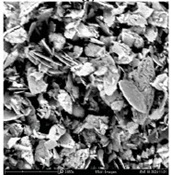
Metodología: se realizaron lixiviaciones de roca fosfórica utilizando ácido nítrico a tres concentraciones diferentes: 2, 4 y 5 M. Posteriormente, el licor de lixiviación se neutralizó con hidróxido de sodio (NaOH) en tres rangos de pH: 3–4, 4–5 y 6–7. Los productos obtenidos fueron caracterizados mediante fluorescencia de rayos X (FRX), difracción de rayos X (DRX) y microscopía electrónica de barrido (SEM) con el fin de verificar la presencia de la fase monetita y su morfología.
Resultados: los resultados mostraron que la fase monetita presenta mayor estabilidad en un rango de pH entre 3 y 4. Asimismo, se determinó que puede obtenerse monetita con una pureza del 100% utilizando concentraciones de NaOH de 2 M y 5 M. En condiciones de pH neutro se evidenció la precipitación y estabilidad de otras fases, como la hidroxiapatita.
Conclusiones: la obtención directa de monetita a partir de roca fosfórica de Boyacá es viable bajo condiciones controladas de pH y concentración, destacándose el rango ácido como el más favorable para su estabilidad.
Xie C, Lu H, Li W, Yi-Min Z. The use of calcium phosphate-based biomaterials in implant dentistry. J Mater Sci Mater Med. 2011;23:853–62. doi:10.1007/s10856-011-4535-9.
Medvecky L, Stulajterova R, Giretova M, Sopcak T, Girman V. Reinforcement of hydroxyapatite ceramics by soaking green samples of tetracalcium phosphate/monetite mixture in aqueous solutions. Ceram Int. 2022;48(12):17776–88. doi:10.1016/j.ceramint.2022.03.048.
Ma MG, Zhu YJ, Chang J. Monetite formed in mixed solvents of water and ethylene glycol and its transformation to hydroxyapatite. J Phys Chem B. 2006;110(29):14226–30. doi:10.1021/jp061738r.
Stulajterova R, Medvecky L, Giretova M, Sopcak T, Luptakova L, Bures R, et al. Characterization of tetracalcium phosphate/monetite biocement modified by magnesium pyrophosphate. Materials (Basel). 2022;15(7):2586. doi:10.3390/ma15072586.
Tas AC. Monetite (CaHPO4) synthesis in ethanol at room temperature. J Am Ceram Soc. 2009;92(12):2907–12. doi:10.1111/j.1551-2916.2009.03351.x.
Tortet L, Gavarri JR, Nihoul G, Dianoux AJ. Study of protonic mobility in CaHPO4·2H2O (brushite) and CaHPO4 (monetite) by infrared spectroscopy and neutron scattering. J Solid State Chem. 1997;132:SC977383.
Wang Z, Li Q, Ren S, Zhang H, Chen J, Li A, et al. Composite monetite/amorphous calcium phosphate bone cement promotes bone regeneration. Ceram Int. 2023;49(5):7888–904. doi:10.1016/j.ceramint.2022.10.296.
Zhou H, Yang L, Gbureck U, Bhaduri SB, Sikder P. Monetite, an important calcium phosphate compound–Its synthesis, properties and applications in orthopedics. Acta Biomater. 2021;127:41–55. doi:10.1016/j.actbio.2021.03.050.
Le HR, Chen KY, Wang CA. Effect of pH and temperature on the morphology and phases of co-precipitated hydroxyapatite. J Sol-Gel Sci Technol. 2012;61(3):592–9. doi:10.1007/s10971-011-2665-7.
Sakka S, Bouaziz J, Ben F. Mechanical properties of biomaterials based on calcium phosphates and bioinert oxides for applications in biomedicine. In: Advances in Biomaterials Science and Biomedical Applications. 2013. doi:10.5772/53088.
Mishchenko O, Yanovska A, Kosinov O, Maksymov D, Moskalenko R, Ramanavicius A, et al. Synthetic calcium–phosphate materials for bone grafting. Polymers (Basel). 2023;15:3822. doi:10.3390/polym15183822.
Shen J, Evangelista MF, Mkongo G, Wen H, Langford R, Rosair G, et al. Efficient defluoridation of water by Monetite nanorods. Adsorption. 2018;24(2):135–45. doi:10.1007/s10450-017-9928-8.
Tamimi F, Sheikh Z, Barralet J. Dicalcium phosphate cements: brushite and monetite. Acta Biomater. 2012;8(2):474–87. doi:10.1016/j.actbio.2011.08.005.
Suchanek K, Bartkowiak A, Perzanowski M, Marszałek M. From monetite plate to hydroxyapatite nanofibers by monoethanolamine assisted hydrothermal approach. Sci Rep. 2018;8(1). doi:10.1038/s41598-018-33936-4.
Akram M, Ahmed R, Shakir I, Ibrahim WAW, Hussain R. Extracting hydroxyapatite and its precursors from natural resources. J Mater Sci. 2014;49(4):1461–75. doi:10.1007/s10853-013-7864-x.
Le HR, Chen KY, Wang CA. Effect of pH and temperature on the morphology and phases of co-precipitated hydroxyapatite. J Sol-Gel Sci Technol. 2012;61(3):592–9. doi:10.1007/s10971-011-2665-7.
Dorozhkin SV. Calcium orthophosphate (CaPO4): occurrence and properties. Prog Biomater. 2016;5:9–70. doi:10.1007/s40204-015-0045-z.
Sergey V, Matthias E. Biological and medical significance of calcium phosphates. Angew Chem Int Ed. 2002;41:3130–46. doi:10.1002/1521-3773(20020902)41.
Gbureck U, Dembski S, Thull R, Barralet JE. Factors influencing calcium phosphate cement shelf-life. Biomaterials. 2005;26:3691–7. doi:10.1016/j.biomaterials.2004.09.036.
Kumar RR, Wang M. Biomimetic deposition of hydroxyapatite on brushite single crystals grown by the gel technique. Mater Lett. 2001;49:15–9. doi:10.1016/s0167-577x(00)00333-5.
Higuita LP, Vargas AF, Gil MJ, Giraldo LF. Synthesis and characterization of nanocomposite based on hydroxyapatite and monetite. Mater Lett. 2016;175:169–72. doi:10.1016/j.matlet.2016.04.011.
Duncan J, MacDonald JF, Hanna JV, Shirosaki Y, Hayakawa S, Osaka A, et al. The role of the chemical composition of monetite on the synthesis and properties of α-tricalcium phosphate. Mater Sci Eng C. 2014;34:123–9. doi:10.1016/j.msec.2013.08.038.
Dorozhkin S. Calcium orthophosphates: Occurrence, properties, biomineralization, pathological calcification and biomimetic applications. Biomatter. 2011;1:121–64. doi:10.4161/biom.18790.
Macha IJ, Ozyegin L, Chou J, Samur R, Oktar FAIK, Ben-Nissan B. An alternative synthesis method for di calcium phosphate (Monetite) powders from mediterranean mussel (Mytilus galloprovincialis) shells. J Aust Ceram Soc. 2013;49(2):122–8. Available from: www.austceram.com/ACS-Journal.
Canillas M, Pena P, de Aza AH, Rodríguez MA. Calcium phosphates for biomedical applications. Bol Soc Esp Ceram Vidrio. 2017;56(3):91–112. doi:10.1016/j.bsecv.2017.05.001.
Avşar C, Gezerman AO. An evaluation of phosphogypsum (PG)-derived nanohydroxyapatite (HAP) synthesis methods and waste management as a phosphorus source in the agricultural industry. Medziagotyra. 2023;29(2):247–54. doi:10.5755/j02.ms.31695.
Bouchkira I, Latifi AM, Khamar L, Benjelloun S. Modeling and multi-objective optimization of the digestion tank of an industrial process for manufacturing phosphoric acid by wet process. Comput Chem Eng. 2022;156:107536. doi:10.1016/j.compchemeng.2021.107536.
Ryszko U, Rusek P, Kołodyńska D. Quality of phosphate rocks from various deposits used in wet phosphoric acid and P-fertilizer production. Materials (Basel). 2023;16(2):20793. doi:10.3390/ma16020793.
Javied S, Waheed S, Siddique N, Tufail M, Chaudhry MM, Irfan N. Elemental analysis of phosphate rocks: for sustainable agriculture in Pakistan. J Radioanal Nucl Chem. 2008;278(1):17–24. doi:10.1007/s10967-007-7205-0.
Downloads

Esta obra está bajo una licencia internacional Creative Commons Atribución-NoComercial-CompartirIgual 4.0.
Los autores que publican en esta revista están de acuerdo con los siguientes términos:
Los autores ceden los derechos patrimoniales a la revista y a la Universidad del Valle sobre los manuscritos aceptados, pero podrán hacer los reusos que consideren pertinentes por motivos profesionales, educativos, académicos o científicos, de acuerdo con los términos de la licencia que otorga la revista a todos sus artículos.
Los artículos serán publicados bajo la licencia Creative Commons 4.0 BY-NC-SA (de atribución, no comercial, sin obras derivadas).