
Sensor de humedad basado en carbono derivado de cascarilla de arroz

Palabras clave:
carbono, pirólisis, caracterización de materiales, sensorBarra lateral del artículo
Contenido principal del artículo
Introducción: Los materiales carbonosos derivados de residuos agrícolas, como la cascarilla de arroz (HR), han despertado un creciente interés debido a su potencial en aplicaciones sostenibles, especialmente en los campos de la electrónica, la detección ambiental y el almacenamiento de energía.
Objetivos: Este estudio tiene como objetivo investigar la síntesis de materiales carbonosos a partir de HR mediante descomposición térmica a distintas temperaturas (900 °C y 1000 °C), y evaluar su aplicación en la fabricación de sensores de humedad, analizando cómo la temperatura de carbonización afecta sus propiedades estructurales y funcionales.
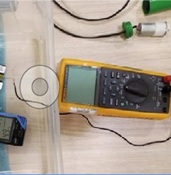
Materiales y Métodos: Se sintetizaron materiales carbonosos a partir de HR mediante pirólisis a 900 °C y 1000 °C. Las propiedades estructurales y el grado de grafitización se caracterizaron mediante difracción de rayos X (DRX) y espectroscopia Raman. Posteriormente, los materiales obtenidos se integraron en tintas conductoras, empleando distintos aglutinantes y disolventes, para fabricar sensores resistivos. La respuesta eléctrica de estos sensores se evaluó en condiciones de humedad relativa controlada.
Resultados: Los análisis estructurales indicaron que una mayor temperatura de carbonización favorece la formación de estructuras más cristalinas y un mayor grado de grafitización. Los sensores fabricados mostraron diferentes respuestas eléctricas según la temperatura de pirólisis, evidenciando una relación variable entre la resistencia y la humedad relativa.
Conclusiones: La temperatura de carbonización tiene un impacto significativo en las propiedades estructurales y funcionales de los materiales carbonosos derivados de HR. Estos resultados demuestran el potencial de estos materiales para ser optimizados en aplicaciones de detección ambiental, específicamente en la monitorización de la humedad, contribuyendo al desarrollo de soluciones sostenibles en electrónica flexible e impresa.
(1) Durga M L, Gangil S, Bhargav V K. Conversion of agricultural waste to valuable carbonaceous material: Brief review'. Mater Today Proc, 2022, 56:1290-1297. https://doi.org/10.1016/j.matpr.2021.11.259 DOI: https://doi.org/10.1016/j.matpr.2021.11.259
(2) Khoshnood E, Motlagh N, Asasian-Kolur S. A comparative study on rice husk and rice straw as bioresources for production of carbonaceous adsorbent and silica', Biomass Convers Biorefin, 2022, 12(12): 5729-5738. https://doi.org/10.1007/s13399-020-01145-7 DOI: https://doi.org/10.1007/s13399-020-01145-7
(3) Mesa S, Jaramillo DL, Urán C, Vélez C. A. Amorphous silica production from Colombian rice husk: demonstration in scaled-up process Products'. Ingeniería y Competitividad, 2024, 26, (3). https://doi.org/10.25100/iyc.v26i3.14396 DOI: https://doi.org/10.25100/iyc.v26i3.14396
(4) F Akhter S A, Soomro A R, Jamali Z A. Chandio M. Siddique, and M. Ahmed, 'Rice husk ash as green and sustainable biomass waste for construction and renewable energy applications: a review', Biomass Convers Biorefin, 2023, 13, (6):4639-4649. https://doi.org/10.1007/s13399-021-01527-5 DOI: https://doi.org/10.1007/s13399-021-01527-5
(5) Vela-Carrillo A Z. et al., Carbon Paste Electrodes Obtained from Organic Waste After a Biodrying Process and Validation in an Electro-Fenton System Towards Alternative Valorization. J Mex Chem Soc, 2023, 67(4): 359-370. https://doi.org/10.29356/jmcs.v67i4.1962 DOI: https://doi.org/10.29356/jmcs.v67i4.1962
(6) Ortiz-Martínez A K, Godínez L A, Martínez-Sánchez C J, García-Espinoza D, Robles I. Preparation of modified carbon paste electrodes from orange peel and used coffee ground. New materials for the treatment of dye-contaminated solutions using electro-Fenton processes. Electrochim Acta, 2021, 390: 138861. https://doi.org/10.1016/j.electacta.2021.138861 DOI: https://doi.org/10.1016/j.electacta.2021.138861
(7) Malode S J, Sharma P, Hasan M R, Shetti N P, Mascarenhas R J. Carbon and carbon paste electrodes. Electrochemical Sensors, Elsevier, 2022, 79-114. https://doi.org/10.1016/B978-0-12-823148-7.00004-0 DOI: https://doi.org/10.1016/B978-0-12-823148-7.00004-0
(8) Shahi N, Lee E, Min B, Kim D J. Rice Husk-Derived Cellulose Nanofibers: A Potential Sensor for Water-Soluble Gases. Sensors, 2021, 21(13): 4415. https://doi.org/10.3390/s21134415 DOI: https://doi.org/10.3390/s21134415
(9) Ziegler D, Boschetto F, Marin E, Palmero P, Pezzotti G, Tulliani J M. Rice husk ash as a new humidity sensing material and its aging behavior. Sens Actuators B Chem, 2021, 328:129049, https://doi.org/10.1016/j.snb.2020.129049 DOI: https://doi.org/10.1016/j.snb.2020.129049
(10) Fathy N A, Sayed Ahmed S A, Aboelenin R M, El-Shafey S S. Fabrication and optimization of activated carbon-based graphene oxide from rice husks as an alternative to graphite', New Journal of Chemistry, 2024, 48(17): 7726-7738. https://doi.org/10.1039/D4NJ00475B DOI: https://doi.org/10.1039/D4NJ00475B
(11) Swetha N, Venkata Lakshmi V, Mylarappa M, Chandruvasan S, Harisha K S. Development of SiO2/rGO from Rice Husk for Photocatalysis, Antioxidant, Electrochemical and Green Sensor Detection Studies. Silicon, 2024, 16 (9):4037-4059. https://doi.org/10.1007/s12633-024-02938-5
(12) Castro-Ladino J R, Cuy-Hoyos C A, Prías-Barragán J J. Basic physical properties and potential application of graphene oxide fibers synthesized from rice husk. Sci Rep, 2023, 13 (1):17967. https://doi.org/10.1038/s41598-023-45251-8 DOI: https://doi.org/10.1038/s41598-023-45251-8
(13) Javier J R, Vacca-Casanova A B, Cuy-Hoyos C A. Pyrolysis system to obtain carbonaceous material from rice husk used as a precursor. Rev Acad Colomb Cienc Exactas Fis Nat, 2020, 44(172): 805-813. https://doi.org/10.18257/raccefyn.1109 DOI: https://doi.org/10.18257/raccefyn.1109
(14) Liou T H, Wang PY. Utilization of rice husk wastes in synthesis of graphene oxide-based carbonaceous nanocomposites. Waste Management, 2020,108: 51-61. https://doi.org/10.1016/j.wasman.2020.04.029 DOI: https://doi.org/10.1016/j.wasman.2020.04.029
(15) Al-Gaashani R, Najjar A, Zakaria Y, Mansour S, Atieh M A. XPS and structural studies of high quality graphene oxide and reduced graphene oxide prepared by different chemical oxidation methods. Ceram Int, 2019, 45(11):14439-14448. https://doi.org/10.1016/j.ceramint.2019.04.165 DOI: https://doi.org/10.1016/j.ceramint.2019.04.165
(16) Stobinski L, et al., Graphene oxide and reduced graphene oxide studied by the XRD, TEM and electron spectroscopy methods. J Electron Spectros Relat Phenomena, 2014, 195: 145-154. https://doi.org/10.1016/j.elspec.2014.07.003 DOI: https://doi.org/10.1016/j.elspec.2014.07.003
(17) Tian Y, Lin Y, Hagio T, Hu Y H. Surface-microporous graphene for CO2 adsorption. Catal Today, 2020, 356: 514-518. https://doi.org/10.1016/j.cattod.2020.06.002 DOI: https://doi.org/10.1016/j.cattod.2020.06.002
(18) Ismail M S, et al. Synthesis and characterization of graphene derived from rice husks. Malaysian Journal of Fundamental and Applied Sciences, 2019, 15(4): 516-521. https://doi.org/10.11113/mjfas.v15n4.1228 DOI: https://doi.org/10.11113/mjfas.v15n4.1228
(19) Arias‐Niquepa R A, Prías‐Barragán J J, Ariza‐Calderón H, Rodríguez‐García M E. Activated Carbon Obtained from Bamboo: Synthesis, Morphological, Vibrational, and Electrical Properties and Possible Temperature Sensor. Physica status solidi (a), 2019, 216 (4) https://doi.org/10.1002/pssa.201800422 DOI: https://doi.org/10.1002/pssa.201800422
(20) Hidayat S, Ardiaksa P, Riveli N, Rahayu I. Synthesis and characterization of carboxymethyl cellulose (CMC) from salak-fruit seeds as anode binder for lithium-ion battery. J Phys Conf Ser, 2018, 1080: 012017. https://doi.org/10.1088/1742-6596/1080/1/012017 DOI: https://doi.org/10.1088/1742-6596/1080/1/012017
(21) Maizal Hairi N I I, et al. Recent advance in using eco-friendly carbon-based conductive ink for printed strain sensor: A review. Cleaner Materials, 2024,12:100248. https://doi.org/10.1016/j.clema.2024.100248 DOI: https://doi.org/10.1016/j.clema.2024.100248
(22) Gubbels F, An overview of the chemistry of condensation curing silicone sealants and adhesives. Int J Adhes Adhes, 2024, 132:103728. https://doi.org/10.1016/j.ijadhadh.2024.103728 DOI: https://doi.org/10.1016/j.ijadhadh.2024.103728
(23) Walker P L, Thrower P A. Chemistry and Physics of Carbon. Boca Raton: CRC Press, 2021. https://doi.org/10.1201/9781003209065 DOI: https://doi.org/10.1201/9781003209065
(24) Zhang H, Yang Y, Ren D, Wang L, He X. Graphite as anode materials: Fundamental mechanism, recent progress and advances. Energy Storage Mater, 2021, 36:147-170. https://doi.org/10.1016/j.ensm.2020.12.027 DOI: https://doi.org/10.1016/j.ensm.2020.12.027
(25) Reina G, González-Domínguez J M, Criado A, Vázquez E, Bianco A, Prato M. Promises, facts and challenges for graphene in biomedical applications. Chem Soc Rev, 2017, 46(15): 4400-4416. https://doi.org/10.1039/C7CS00363C DOI: https://doi.org/10.1039/C7CS00363C
(26) Shadabfar M, Ehsani M, Khonakdar H A, Abdouss M, Ameri T. Waterborne conductive carbon paste with an eco-friendly binder. Cellulose,2023, 30(3):1759-1772. https://doi.org/10.1007/s10570-022-04998-5 DOI: https://doi.org/10.1007/s10570-022-04998-5
(27) Liu Z, Chen K, Heng C, Dong L, Lin Y. Review on Degradation Behaviors of Silicone Rubber Under Ultraviolet Radiation for Outdoor Insulators. IEEE 7th International Electrical and Energy Conference (CIEEC), IEEE, 2024:1490-1495 https://doi.org/10.1109/CIEEC60922.2024.10583189 DOI: https://doi.org/10.1109/CIEEC60922.2024.10583189
(28) Yang H, Wen R, Zhao H, Guo M, Zhang L, Chen Y. Study on ageing characteristics and evaluation methods of RTV silicone rubber in high humidity area. PLoS One, 2021, 16(6): e0251092. https://doi.org/10.1371/journal.pone.0251092 DOI: https://doi.org/10.1371/journal.pone.0251092
(29) Jessy Mercy D, Kiran V, Thirumalai A, Harini K, Girigoswami K, Girigoswami A. Rice husk assisted carbon quantum dots synthesis for amoxicillin sensing. Results Chem, 2023, 6: 101219. https://doi.org/10.1016/j.rechem.2023.101219 DOI: https://doi.org/10.1016/j.rechem.2023.101219
(30) Sumaila JL, et al., 'Morphology and Electrical Properties of Pristine and Composite Rice Husk Ash Nano/Micro Particles Thick Films for Gas Sensing Applications. IEEE Regional Symposium on Micro and Nanoelectronics (RSM), IEEE, 2023: 90-93. https://doi.org/10.1109/RSM59033.2023.10327321 DOI: https://doi.org/10.1109/RSM59033.2023.10327321
(31) Swetha N, Venkata Lakshmi V, Mylarappa M, Chandruvasan S, Harisha K S, Development of SiO2/rGO from Rice Husk for Photocatalysis, Antioxidant, Electrochemical and Green Sensor Detection Studies. Silicon, 2024, 16(9):4037-4059. https://doi.org/10.1007/s12633-024-02938-5 DOI: https://doi.org/10.1007/s12633-024-02938-5
(32) You H, et al. Sustainable Production of Biomass‐Derived Graphite and Graphene Conductive Inks from Biochar. Small, 2024, 20(52) https://doi.org/10.1002/smll.202406669 DOI: https://doi.org/10.1002/smll.202406669
##plugins.themes.bootstrap3.displayStats.downloads##

Esta obra está bajo una licencia internacional Creative Commons Atribución-NoComercial-CompartirIgual 4.0.
Los autores que publican en esta revista están de acuerdo con los siguientes términos:
Los autores ceden los derechos patrimoniales a la revista y a la Universidad del Valle sobre los manuscritos aceptados, pero podrán hacer los reusos que consideren pertinentes por motivos profesionales, educativos, académicos o científicos, de acuerdo con los términos de la licencia que otorga la revista a todos sus artículos.
Los artículos serán publicados bajo la licencia Creative Commons 4.0 BY-NC-SA (de atribución, no comercial, sin obras derivadas).