
Materiales de origen biológico para la remediación ambiental de aguas contaminadas con tartrazina: una revisión

Palabras clave:
Adsorción, colorantes azoicos, biocarbón, biopolímeros, tartrazina, tratamiento de aguas residualesBarra lateral del artículo
Contenido principal del artículo
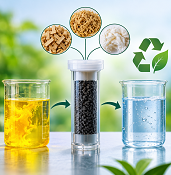
Introducción: La presencia persistente de tartrazina (FDC Yellow) en entornos acuáticos, derivada de su uso generalizado en las industrias alimentaria, textil, farmacéutica y cosmética, conlleva riesgos para el medio ambiente y la salud pública. Se requieren alternativas más económicas y respetuosas con el medio ambiente, dado que las tecnologías de remediación convencionales resultan costosas de operar y presentan una sostenibilidad limitada.
Objetivo: Esta revisión narrativa evalúa el progreso de la investigación en los últimos 25 años sobre la adsorción mediante materiales de origen biológico para la eliminación de tartrazina. El propósito es analizar dichos adsorbentes, identificar materiales de alta eficiencia, señalar los obstáculos técnicos y detectar las lagunas de conocimiento que dificultan su aplicación a escala industrial.
Métodos: Se realizó una búsqueda bibliográfica centrada en estudios publicados entre 2000 y 2025, utilizando las bases de datos OpenAlex, Google Scholar y DOAJ. Los bioadsorbentes se clasificaron en subproductos agrícolas, carbonos derivados de biomasa y polímeros naturales, prestando especial atención a los métodos de preparación, los mecanismos de adsorción y el rendimiento bajo diversas condiciones operativas.
Resultados: Los adsorbentes basados en carbono —activados química o térmicamente—, con capacidades de adsorción de 110 a 1136 mg g⁻¹, ofrecen un mejor desempeño que los residuos agrícolas sin modificar (como la cascarilla de arroz o el bagazo de caña de azúcar), los cuales presentan capacidades moderadas, situadas entre 1 y 91 mg g⁻¹. No obstante, persisten desafíos importantes en cuanto a la regeneración de los adsorbentes, su estabilidad mecánica, la variabilidad entre lotes y la escalabilidad industrial.
Conclusiones: La adsorción mediante materiales de origen biológico ha demostrado un potencial considerable para la eliminación de tartrazina a escala de laboratorio. La investigación futura debe centrarse en el desarrollo de materiales compuestos híbridos, sistemas de flujo continuo y evaluaciones técnico-económicas integrales, con el fin de facilitar la transición de estas innovaciones hacia aplicaciones prácticas en el tratamiento de agua.
1. Islam MdM, Aidid AR, Mohshin JN, Mondal H, Ganguli S, Chakraborty AK. A critical review on textile dye-containing wastewater: Ecotoxicity, health risks, and remediation strategies for environmental safety. Cleaner Chemical Engineering, (2025) 11:100165.
https://doi.org/10.1016/j.clce.2025.100165
2. Ali MA, Mubarak MF, Keshawy M, Zayed MA, Ataalla M. Adsorption of Tartrazine anionic dye by novel fixed bed Core-Shell- polystyrene Divinylbenzene/Magnetite nanocomposite. Alexandria Engineering Journal, (2022) 61(2),1335-52.
https://doi.org/10.1016/j.aej.2021.06.016
3. Jadhav S, Jaspal D. Adsorptive eradication of tartrazine from aqueous solutions onto doped polyaniline. Journal of the Serbian Chemical Society, (2020) 85(2), 251-63. https://doi.org/10.2298/JSC190705116J
4. Haridevamuthu B, Murugan R, Seenivasan B, Meenatchi R, Pachaiappan R, Almutairi BO, et al. Synthetic azo-dye, Tartrazine induces neurodevelopmental toxicity via mitochondria-mediated apoptosis in zebrafish embryos. Journal of Hazardous Materials, (2024) 461:132524.
5. Khader EH, Mohammed TJ, Albayati TM. Comparative performance between rice husk and granular activated carbon for the removal of azo tartrazine dye from aqueous solution. Desalination and Water Treatment, (2021) J229, 372-83.
https://doi.org/10.5004/dwt.2021.27374
6. Madeira CSP, Zavarize DG, Vieira GEG. Optimized adsorption onto biosolids-based activated carbon for tartrazine removal from wastewater. Water Environment Research, (2019 91(5), 417-27. https://doi.org/10.1002/wer.1039
7. Ansari R, Banimahd Keivani M, Fallah Delavar A. Application of polyaniline nanolayer composite for removal of tartrazine dye from aqueous solutions. Journal of Polymer Research, (2011) 18(6),1931–9. https://doi.org/10.1007/s10965-011-9600-z
8. Zhang L, Sellaoui L, Franco D, Dotto GL, Bajahzar A, Belmabrouk H, et al. Adsorption of dyes brilliant blue, sunset yellow and tartrazine from aqueous solution on chitosan: Analytical interpretation via multilayer statistical physics model. Chemical Engineering Journal, (2020) 382, 122952. https://doi.org/10.1016/j.cej.2019.122952
9. Priem J, Piwowar H, Orr R. OpenAlex: A fully-open index of scholarly works, authors, venues, institutions, and concepts. 26th International Conference on Science and Technology Indicators (STI), Granada, Spain, (2022), Sep 7-9.
10. Blachnio M, Zienkiewicz-Strzalka M, Derylo-Marczewska A. Synthesis of Composite Sorbents with Chitosan and Varied Silica Phases for the Adsorption of Anionic Dyes. Molecules, (2024) 29(9), 2087. https://doi.org/10.3390/molecules29092087
11. Tejada-Tovar C, Villabona-Ortiz Á, Aguilar-Bermúdez F, Pájaro-Moreno Y, González-Delgado ÁD. Evaluation of Adsorbent Biomaterials Based on Coconut Mesocarp for Treatment of Wastewater Contaminated with Tartrazine Dye. Processes, (2023) 11(11), 3115. https://doi.org/10.3390/pr11113115
12. Leulescu M, Rotaru A, Pălărie I, Moanţă A, Cioateră N, Popescu M, et al. Tartrazine: physical, thermal and biophysical properties of the most widely employed synthetic yellow food-colouring azo dye. Journal of Thermal Analysis and Calorimetry, (2018) 134(1), 209–31.
https://doi.org/10.1007/s10973-018-7663-3
13. Annadurai G, Juang R, Lee D. Use of cellulose-based wastes for adsorption of dyes from aqueous solutions. Journal of Hazardous Materials, (2002) 92(3), 263–74.
https://doi.org/10.1016/S0304-3894(02)00017-1
14. Albadarin AB, Charara M, Abu Tarboush BJ, Ahmad MNM, Kurniawan TA, Naushad Mu, et al. Mechanism analysis of tartrazine biosorption onto masau stones; a low cost by-product from semi-arid regions. Journal of Molecular Liquids, (2017) 242, 478–83. https://doi.org/10.1016/j.molliq.2017.07.045
15. Dos Santos LN, Porto CE, Bulla MK, Batistela VR, Barros BCB. Peach palm and cassava wastes as biosorbents of tartrazine yellow dye and their application in industrial effluent. Scientia Plena, (2021) 17(5), 1-19.
https://doi.org/10.14808/sci.plena.2021.054201
16. Mujtaba G, Hai A, Ul Hassan Shah M, Ullah A, Anwar Y, Shah F, et al. Potential of Capparis decidua plant and eggshell composite adsorbent for effective removal of anionic dyes from aqueous medium. Environmental Research, (2024) 247, 118279.
https://doi.org/10.1016/j.envres.2024.118279
17. Rêgo TV, Cadaval TRS, Dotto GL, Pinto LAA. Statistical optimization, interaction analysis and desorption studies for the azo dyes adsorption onto chitosan films. Journal of Colloid and Interface Science, (2013) 411,27-33.
https://doi.org/10.1016/j.jcis.2013.08.051
18. Qian W, Hu M, Su Y, Shan S, Zhang Z, Hu L, et al. Insight into mass transfer during adsorption of geniposidic acid onto a fixed-bed column by numerical simulation considering influence of operating conditions on column adsorption performance. Separation and Purification Technology, (2023) 319, 124021.
https://doi.org/10.1016/j.seppur.2023.124021
19. Reck IM, Paixão RM, Bergamasco R, Vieira MF, Vieira AMS. Removal of tartrazine from aqueous solutions using adsorbents based on activated carbon and Moringa oleifera seeds. Journal of Cleaner Production. 2018 Jan;171:85–97.
https://doi.org/10.1016/j.jclepro.2017.09.237
20. Heo S, Kim W, Jo Y, Adelodun AA. Fabrication of bamboo-based activated carbon for low-level CO2 adsorption toward sustainable indoor air. Sustainability, (2024) 16(4), 1634. https://doi.org10.3390/su16041634
21. Karimi M, Shirzad M, Silva JA, Rodrigues AE. Biomass/Biochar carbon materials for CO2 capture and sequestration by cyclic adsorption processes: A review and prospects for future directions. Journal of CO2 Utilization, (2022) 57, 101890.
https://doi.org/10.1016/j.jcou.2022.101890
22. Poonam, Rani A & Sharma PK. Biosorption: Principles, and Applications. In: Gupta LM, Ray MR, Labhasetwar PK (editors). Advances in Civil Engineering and Infrastructural Development, (2021) 87, 501–10.
https://doi.org/10.1007/978-981-15-6463-5_48
23. Xu C & Strømme M. Sustainable porous carbon materials derived from wood-based biopolymers for CO2 capture. Nanomaterials, (2019) 9(1), 103.
https://doi.org/10.3390/nano9010103
24. Gautam PK, Gautam RK, Banerjee S, Lofrano G, Sanroman MA, Chattopadhyaya MC, et al. Preparation of activated carbon from Alligator weed (Alternenthera philoxeroids) and its application for tartrazine removal: Isotherm, kinetics and spectroscopic analysis. Journal of Environmental Chemical Engineering, (2015) 3(4), 2560–2568.
https://doi.org/10.1016/j.jece.2015.08.004
25. Gautam RK, Gautam PK, Banerjee S, Rawat V, Soni S, Sharma SK, et al. Removal of tartrazine by activated carbon biosorbents of Lantana camara: Kinetics, equilibrium modeling and spectroscopic analysis. Journal of Environmental Chemical Engineering, 2015 3(1), 79–88. https://doi.org/10.1016/j.jece.2014.11.026
26. Torres-Pérez J, Soria-Serna LA, Solache-Ríos M, McKay G. One Step Carbonization/Activation Process for Carbonaceous Material Preparation from Pecan Shells for Tartrazine Removal and Regeneration after Saturation. Adsorption Science & Technology, 2015 33(10), 895–913. https://doi.org/10.1260/0263-6174.33.10.895
27. Albroomi HI, Elsayed MA, Baraka A, Abdelmaged MA. Batch and fixed-bed adsorption of tartrazine azo-dye onto activated carbon prepared from apricot stones. Applied Water Science, (2017) 7(4), 2063–74.
https://doi.org/10.1007/s13201-016-0387-2
28. Mahmoud ME, Abdelfattah AM, Tharwat RM, Nabil GM. Adsorption of negatively charged food tartrazine and sunset yellow dyes onto positively charged triethylenetetramine biochar: Optimization, kinetics and thermodynamic study. Journal of Molecular Liquids, (2020) 318, 114297. https://doi.org/10.1016/j.molliq.2020.114297
29. Chukwuemeka-Okorie HO, Ekuma FK, Akpomie KG, Nnaji JC, Okereafor AG. Adsorption of tartrazine and sunset yellow anionic dyes onto activated carbon derived from cassava sievate biomass. Applied Water Science, (2021) 11(2), 27.
https://doi.org/10.1007/s13201-021-01357-w
30. Perveen S, Nadeem R, Nosheen F, Asjad MI, Awrejcewicz J, Anwar T. Biochar-Mediated Zirconium Ferrite Nanocomposites for Tartrazine Dye Removal from Textile Wastewater. Nanomaterials, (2022) 12(16), 2828.
https://doi.org/10.3390/nano12162828
31. Soran ML, Bocșa M, Pintea S, Stegarescu A, Lung I, Opriş O. Commercially Biochar Applied for Tartrazine Removal from Aqueous Solutions. Applied Sciences, (2023) 14(1), 53. https://doi.org/10.3390/app14010053
32. Liu W, Wu F, Fan M, Zhang S, Wang S, Hu X. Activation of poplar with H3PO4 and H2SO4: Synergistic effects of dual acids on pore development of activated carbon for enhanced adsorption of phenol and tetracycline. Colloids and Surfaces A: Physicochemical and Engineering Aspects, (2025) 138861. https://doi.org/10.1016/j.colsurfa.2025.138861
33. Akl MA, Serage AA. Chitosan impregnated sugarcane bagasse biochar for removal of anionic dyes from wastewater. Scientific Reports, (2024) 14(1), 27097.
https://doi.org/10.1038/s41598-024-77708-9
34. Salehi M, Rashidinejad A. Multifaceted roles of plant-derived bioactive polysaccharides: A review of their biological functions, delivery, bioavailability, and applications within the food and pharmaceutical sectors. International Journal of Biological Macromolecules, (2025) 290, 138855. https://doi.org/10.1016/j.ijbiomac.2024.138855
35. Benalaya I, Alves G, Lopes J, Silva LR. A Review of Natural Polysaccharides: Sources, Characteristics, Properties, Food, and Pharmaceutical Applications. International Journal of Molecular Sciences, (2024) 25, 1322.
https://doi.org/10.3390/ijms25021322
36. Wu H, Zhou J, Zhang S, Niu P, Li H, Liu Z, et al. A Comparative Study of Removal of Acid Red 27 by Adsorption on Four Different Chitosan Morphologies. Polymers, (2024) 16(7), 1019. https://doi.org/10.3390/polym16071019
37. Stick RV, Williams SJ. Carbohydrates: the essential molecules of life. 2nd ed. Amsterdam London: Elsevier; 2009.38. Stick RV, Williams SJ. Carbohydrates: the essential molecules of life. 2nd ed. Amsterdam, London: Elsevier; 2009.
38. Lessa EF, Gerhardt R, Arabidian V, da Silva KA, da Silveira Junior N, Jaeschke DP, et al. Synthesis of Chitosan/Carbon Nanotubes Composite Films as Potential Removal of Anionic and Cationic Dyes in Aqueous Solutions. ACS Omega (2025) 10(29), 31840–53. https://doi.org/10.1021/acsomega.5c03164
39. D. Zioui, L. Aoudjit, F. Touahra, and K. Bachari, Preparation and characterization of TiO2-chitosan composite films and application for tartrazine dye degradation, Cellulose Chemistry and Technology (2025) 56, . 9-10, 1101–1107, Nov. 2022,
https://doi.org/10.35812/CelluloseChemTechnol.2022.56.98
40. Wan Ngah WS, Ariff NFM, Hanafiah MAKM. Preparation, Characterization, and Environmental Application of Crosslinked Chitosan-Coated Bentonite for Tartrazine Adsorption from Aqueous Solutions. Water Air Soil Pollut., (2009) 206(1–4), 225–36.
https://doi.org/10.1007/s11270-009-0098-5
41. Silva JM, Farias BS, Gründmann DDR, Cadaval TRS, Moura JM, Dotto GL, et al. Development of chitosan/ Spirulina bio-blend films and its biosorption potential for dyes. Journal of Applied Polymer Science, (2017) 134(11), 44580.
https://doi.org/10.1002/app.44580
42. Sahnoun S, Boutahala M. Adsorption removal of tartrazine by chitosan/polyaniline composite: Kinetics and equilibrium studies. International Journal of Biological Macromolecules, (2018) 114, 1345–53.
https://doi.org/10.1016/j.ijbiomac.2018.02.146
43. Camara AS, Lütke SF, Pinheiro CP, Vieira MLG, Sant’Anna Cadaval TR, De Almeida Pinto LA. Chitosan-coated sand and its application in a fixed-bed column to remove dyes in simple, binary, and real systems. Environmental Science and Pollution Research, (2020) 30, 37938–37945. https://doi.org/10.1007/s11356-020-09924-5
44. Abd El-Fattah W, Guesmi A, Hamadi NB, Houas A, Alotaibi MT, El-Desouky MG, et al. Novel composite from chitosan and a metal-organic framework for removal of tartrazine dye from aqueous solutions; adsorption isotherm, kinetic, and optimization using Box-Benkhen design. International Journal of Biological Macromolecules, (2024) 273, 133015. https://doi.org/10.1016/j.ijbiomac.2024.133015
45. Tan J, Kong L, Huang Q, Gan Y, Lu S. Harnessing the power of polyethyleneimine in modifying chitosan surfaces for efficient anion dyes and hexavalent chromium removal. Environmental Research, (2024) 247, 118192.
https://doi.org/10.1016/j.envres.2024.118192
46. Ayala-Gutierrez D, Zavala-Arce RE, Garcia-Gonzalez A. Evaluation of the effect of chitosan-based film thickness on the adsorption of tartrazine (yellow No. 5). MRS Advances, (2025) 10(6), 789–794. https://doi.org/10.1557/s43580-025-01242-7
47. Liu C, Zhao M, Liu H, Zhang J, Hu Z, Zhang Y, et al. Robust and anti-biofouling bio-based aerogel with Schiff base network stabilized MOFs for efficient removal of tartrazine dye and U(VI) ions. Separation and Purification Technology, (2025) 361, 131277. https://doi.org/10.1016/j.seppur.2024.131277
48. Nouri S, Emtiazi G, Ulag S, Gunduz O, Calikoglu Koyuncu AC, Roghanian R, et al. Advanced 3D-printed bone scaffolds with sodium alginate/Tri-calcium phosphate/probiotic bacterial hydroxyapatite: Enhanced mechanical and biocompatible properties for bone tissue engineering. Polymer, (2024) 311, 127523.
https://doi.org/10.1016/j.polymer.2024.127523
49. Makarova AO, Derkach SR, Khair T, Kazantseva MA, Zuev YF, Zueva OS. Ion-Induced Polysaccharide Gelation: Peculiarities of Alginate Egg-Box Association with Different Divalent Cations. Polymers, (2023) 15(5), 1243.
https://doi.org/10.3390/polym15051243
50. Teshima R, Osawa S, Kawano Y, Hanawa T, Kikuchi A, Otsuka H. Physicochemical Properties of Egg-Box-Mediated Hydrogels with Transiently Decreased pH Employing Carbonated Water. ACS Omega, (2023) 8(8), 7800-7807.
https://doi.org/10.1021/acsomega.2c07552
51. Mohammadabadi IS, Javanbakht V. Fabrication of dual cross-linked spherical treated waste biomass/alginate adsorbent and its potential for efficient removal of lead ions from aqueous solutions. Industrial Crops and Products, (2021) 168, 113575. https://doi.org/10.1016/j.indcrop.2021.113575
52. Saloglu D, Sahin OI. Removal of azo dyes-tartrazine, carmoisine, and Allura Red – from wastewater using Spirulina biomass-immobilized alginate beads: equilibrium, kinetics, thermodynamics, desorption, and reusability. Desalination and Water Treatment, (2021) 220:431–445. https://doi.org/10.5004/dwt.2021.27010
53. Dalponte DI, Mathias ÁL, Jorge RMM. A new green floating photocatalyst with Brazilian bentonite into TiO2/alginate beads for dye removal. Colloids and Surfaces A: Physicochemical and Engineering Aspects, (2021) 627, 127159.
https://doi.org/10.1016/j.colsurfa.2021.127159
54. Fakhri V, Jafari A, Vahed FL, Su CH, Pirouzfar V. Polysaccharides as eco-friendly bio-adsorbents for wastewater remediation: Current state and future perspective. Journal of Water Process Engineering, (2023) 54, 103980.
https://doi.org/10.1016/j.jwpe.2023.103980
55. Villabona-Ortíz Á, Figueroa-Lopez KJ, Ortega-Toro R. Kinetics and Adsorption Equilibrium in the Removal of Azo-Anionic Dyes by Modified Cellulose. Sustainability, (2022) 14(6), 3640. https://doi.org/10.3390/su14063640
56. Dai R, Woo MW, Chen H, Dang X, Mansouri S, Shan Z. Hydrogel beads based on oxidized corn starch cross-linked with gelatin for tartrazine adsorption from aqueous environments. Polym Journal, (2017) 49(7), 549–555.
https://doi.org/10.1038/pj.2017.14
57. Shiralipour R, Larki A. Pre-concentration and determination of tartrazine dye from aqueous solutions using modified cellulose nanosponges. Ecotoxicology and Environmental Safety, (2017) 135, 123–129.
https://doi.org/10.1016/j.ecoenv.2016.09.038
58. Chen Q, Liao J, Zeng S, Zhou L. Facile Fabrication of Porous Adsorbent with Multiple Amine Groups for Efficient and Selective Removal of Amaranth and Tartrazine Dyes from Water. Materials, (2024) 17(10), 2391.
https://doi.org/10.3390/ma17102391
59. Yang H, Shi M, Ma W, Ma X, Zhang J, Wu K, et al. Quaternized cross-linked peach gum polysaccharide as an adsorbent for fast and selective removal of anionic dyes from aqueous solution. International Journal of Biological Macromolecules, (2025) 306, 141571. https://doi.org/10.1016/j.ijbiomac.2025.141571
60. Zhao L, Zhou Y, Zhang J, Liang H, Chen X, Tan H. Natural Polymer-Based Hydrogels: From Polymer to Biomedical Applications. Pharmaceutics, (2023) 15(10), 2514. https://doi.org/10.3390/pharmaceutics15102514
61. Wujcicki Ł, Kluczka J. Recovery of Phosphate(V) Ions from Water and Wastewater Using Chitosan-Based Sorbents Modified-A Literature Review. International Journal of Molecular Sciences, (2023) 24(15), 12060.
https://doi.org/10.3390/ijms241512060
62. Baskar AV, Bolan N, Hoang SA, Sooriyakumar P, Kumar M, Singh L, et al. Recovery, regeneration and sustainable management of spent adsorbents from wastewater treatment streams: A review. Science of The Total Environment, (2022) 822, 153555.
https://doi.org/10.1016/j.scitotenv.2022.153555
63. Rápó E, Tonk S. Factors Affecting Synthetic Dye Adsorption; Desorption Studies: A Review of Results from the Last Five Years (2017–2021). Molecules, (2021) 26(17), 5419. https://doi.org/10.3390/molecules26175419
64. Aoudjit L, Martins PM, Madjene F, Petrovykh DY, Lanceros-Mendez S. Photocatalytic reusable membranes for the effective degradation of tartrazine with a solar photoreactor. Journal of Hazardous Materials, (2018) 344, 408-416,
##plugins.themes.bootstrap3.displayStats.downloads##

Esta obra está bajo una licencia internacional Creative Commons Atribución-NoComercial-CompartirIgual 4.0.
Los autores que publican en esta revista están de acuerdo con los siguientes términos:
Los autores ceden los derechos patrimoniales a la revista y a la Universidad del Valle sobre los manuscritos aceptados, pero podrán hacer los reusos que consideren pertinentes por motivos profesionales, educativos, académicos o científicos, de acuerdo con los términos de la licencia que otorga la revista a todos sus artículos.
Los artículos serán publicados bajo la licencia Creative Commons 4.0 BY-NC-SA (de atribución, no comercial, sin obras derivadas).