
Cuantificación de la potencia compleja instantánea p-q considerando cargas trifásicas equilibradas

Palabras clave:
Circuito Aron, estimación de potencia activa y reactiva, filtros de potencia compleja instantánea, medición de potencia trifásicaBarra lateral del artículo
Contenido principal del artículo
Introducción: la teoría de potencia p-q abarca los sistemas trifásicos equilibrados y resulta fundamental para analizar el flujo de energía en las redes eléctricas inteligentes. El enfoque tradicional, basado en valores eficaces (RMS), permite calcular la potencia media, mientras que la formulación en el dominio del tiempo permite analizar la potencia instantánea y su variación periódica entre ciclos positivos y negativos. Sin embargo, este enfoque no distingue la energía transformada en trabajo útil de aquella que oscila entre la fuente y la carga.
Objetivo: cuantificar la potencia activa y reactiva instantáneas mediante la comparación de cuatro métodos de estimación.
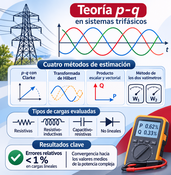
Metodología: se compararon cuatro métodos: teoría p-q basada en la transformada de Clarke, transformada de Hilbert, estimación mediante producto escalar (p) y producto vectorial (q), y método de los dos vatímetros. Se evaluaron cuatro tipos de cargas: resistivas, resistivo-inductivas, capacitivo-resistivas y no lineales. Las estimaciones se contrastaron con valores de referencia obtenidos mediante Simscape/MATLAB, utilizando indicadores de error máximo, error cuadrático medio, error absoluto medio y errores absolutos y relativos de las potencias instantáneas complejas.
Resultados: los métodos presentaron patrones de comportamiento similares y convergencia hacia los valores medios de la potencia compleja. En cargas lineales, los errores relativos fueron inferiores al 0,62 % para la potencia activa y al 0,33 % para la reactiva. Además, el filtrado paso bajo contribuyó a reducir las oscilaciones no deseadas.
Conclusiones: los métodos evaluados presentan comportamientos similares en la estimación de las potencias activa y reactiva instantáneas, con errores relativos inferiores al 1 % en cargas lineales.
1. Salmerón P, Herrera RS. Instantaneous reactive power theory-A general approach to poly-phase systems [Internet]. Vol. 79, Electric Power Systems Research. 2009 [cited 2026 Feb 13]. p. 1263-70.
https://doi.org/10.1016/j.epsr.2009.03.007
2. Tahri A, Draou A. Instantaneous Active and Reactive Power Measuring Method in Three Phase Power System. Leonardo Electron J Pract Technol [Internet]. 2005 [cited 2026 Feb 13];(6):17-28.
https://lejpt.academicdirect.org/A06/17_28.htm
3. Mikkili S, Panda AK. Instantaneous Active and Reactive Power and Current Strategies for Current harmonics cancellation in 3-ph 4wire SHAF With both PI and Fuzzy Controllers. Energy Power Eng [Internet]. 2011 [cited 2026 Feb 13];03(03):285-98.
https://doi.org/10.4236/epe.2011.33036
4. Akagi H, Kanazawa Y, Nabae A. Instantaneous Reactive Power Compensators Comprising Switching Devices without Energy Storage Components. IEEE Trans Ind Appl [Internet]. 1984 [cited 2026 Feb 13];IA-20(3):625-30. Available from:
https://doi.org/10.1109/TIA.1984.4504460
5. Satish G, Rameshkumar K, Dhanasakkaravarthi B, Jeyalakshmi K, Chaudhary S, Singh N. Non-Linear Controller Based 3- φ Shunt Active Filter for Improvement of Power Quality in Non-Linear Load. In: 2023 IEEE International Conference on Integrated Circuits and Communication Systems, ICICACS 2023 [Internet]. Institute of Electrical and Electronics Engineers Inc.
https://doi.org/10.1109/ICICACS57338.2023.10099957
6. Caicedo Peñaranda, E.A, Muegues Serrano H., García Guarin J. Estimador de potencia instantánea en sistemas eléctricos monofásicos. In: XVII Congreso Internacional de Electrónica y Tecnologías de Avanzada. 2025. p. 7.
7. Herrera RS, Salmeron P. Instantaneous reactive power theory: A comparative evaluation of different formulations. IEEE Trans Power Deliv [Internet]. 2007 Jan [cited 2026 Feb 17];22(1):595-604. Available from:
https://doi.org/10.1109/TPWRD.2006.881468
8. Ustariz-Farfan AJ, Cano-Plata EA, Tacca HE. Teoría generalizada de la potencia instantánea aplicada a la compensación de cargas polifásicas. Ingeniare Rev Chil Ing [Internet]. 2012 [cited 2026 Feb 19];20(2):148-59.
https://doi.org/10.4067/S0718-33052012000200002
9. Yu Y, Zhao W, Li S, Huang S. A Two-Stage Wavelet Decomposition Method for Instantaneous Power Quality Indices Estimation Considering Interharmonics and Transient Disturbances. IEEE Trans Instrum Meas [Internet]. 2021 [cited 2026 Feb 13];70.
https://doi.org/10.1109/TIM.2021.3052554
10. Kirkham H, Strickland D, Berrisford A, Bihler M, Britton J, Kirby R, et al. IEEE 1459 - Standard Definitions for the Measurement of Electric Power Quantities Under Sinusoidal, Nonsinusoidal, Balanced, or Unbalanced Conditions. IEEE Std 1459-2025 (Revision IEEE Std 1459-2010) [Internet]. 2025 [cited 2026 Jun 10];1-61.
https://ieeexplore.ieee.org/document/11004570/
11. Peng FZ, Huang H, Tolbert LM, Lehman B, Li YA. Spacetime pq theory for AC and DC electric power systems. Sci Rep [Internet]. 2025 [cited 2026 Feb 17];15(1). Available from:
https://doi.org/10.1038/s41598-025-90021-3
12. Artemenko MY, Kutafin Y V., Mykhalskyi VM, Chopyk V V., Shapoval IA, Polishchuk SY. Control Strategies for Three-Phase Three-Wire Shunt Active Filter in the Reference Frame of Two-Wattmeter Method. In: Proceedings - IEEE International Conference on Electronics and Nanotechnology, ELNANO [Internet]. 2020 [cited 2026 Feb 13]. p. 780-5.
https://doi.org/10.1109/ELNANO50318.2020.9088885
13. Memon ZA, Uqaili MA, Unar A. Design of Three-Phase Hybrid Active Power Filter for Compensating the Harmonic Currents of Three-Phase System [Internet]. Vol. 31, Mehran University Research Journal of Engineering & Technology. 2012 Apr [cited 2026 Feb 13].
https://arxiv.org/pdf/1604.03223
14. Rajashekaraiah K, De Carne G, Iurlaro C, Semeraro M, Bruno S. P-Q Theory-based Dynamic Load Modelling in Short-Circuit Analysis. In: 2023 8th IEEE Workshop on the Electronic Grid, eGRID 2023 [Internet]. 2023 [cited 2026 Feb 17].
https://doi.org/10.1109/eGrid58358.2023.10380853
15. Artemenko M, Chopyk V, Polishchuk S, Mykhalskyi V, Shapoval I. Integral Power Theory and Active Filtering Using the α-β Reference Frame. IEEE Access [Internet]. 2024 [cited 2026 Feb 13];12:60004-14. Available from:
https://doi.org/10.1109/ACCESS.2024.3393767
16. Montoya FG, Alcayde A, Arrabal-Campos FM, Banos R. How to overcome the limitations of p-q Theory: Geometric algebra power theory to the rescue. In: IEEE PES Innovative Smart Grid Technologies Conference Europe [Internet]. 2020 [cited 2026 Feb 14]. p. 339-43.
https://doi.org/10.1109/ISGT-Europe47291.2020.9248978
17. Czarnecki LS. Instantaneous reactive power p-q theory and power properties of three-phase systems. IEEE Trans Power Deliv [Internet]. 2006 Jan [cited 2026 Feb 13];21(1):362-7.
https://doi.org/10.1109/TPWRD.2005.852348
18. Akagi H, Ogasawara S, Kim H. The theory of instantaneous power in three-phase four-wire systems and its applications. Electr Eng Japan (English Transl Denki Gakkai Ronbunshi) [Internet]. 2001 May [cited 2026 Feb 17];135(3):74-86. Available from:
https://doi.org/10.1002/eej.1035
19. Herrera RS, Salmerón P, Vázquez JR, Litrán SP, Pérez A. Generalized instantaneous reactive power theory in poly-phase power systems. In: 2009 13th European Conference on Power Electronics and Applications, EPE ‘09 [Internet]. 2009 [cited 2026 Feb 17].
https://ieeexplore.ieee.org/abstract/document/5279292/
20. Fiorucci E. The measurement of actual apparent power and actual reactive power from the instantaneous power signals in single-phase and three-phase systems. Electr Power Syst Res [Internet]. 2015 Apr 1 [cited 2026 Feb 17];121:227-42. Available from:
https://doi.org/10.1016/j.epsr.2014.11.002
21. Kumar SS, Arya K, Chandrakala KRMV, Nadar KP. Implementation of Instantaneous P-Q Theory to Improve Power Quality by Shunt Active Power Filter for Non-Linear Loads. In: 2024 IEEE 3rd International Conference on Electrical Power and Energy Systems, ICEPES 2024 [Internet]. 2024 [cited 2026 Feb 13]. Available from:
https://doi.org/10.1109/ICEPES60647.2024.10653568
22. Akagi H, Watanabe EH, Aredes M. The Instantaneous Power Theory. In: Instantaneous Power Theory and Applications to Power Conditioning [Internet]. John Wiley & Sons, Ltd; 2017 [cited 2026 Feb 17]. p. 37-109. Available from:
https://doi.org/10.1002/9781119307181.ch3
23. Mikulović J, Šekara T, Forcan M. Power definitions for three-phase systems in terms of instantaneous symmetrical components. Int J Electr Power Energy Syst [Internet]. 2023 [cited 2026 Feb 17];147. Available from:
https://doi.org/10.1016/j.ijepes.2022.108808
24. Aguilera RP, Acuña P, Rojas C, Pou J, Konstantinou G, Watanabe EH. An Instantaneous Power Theory Extension for the Interphase Power Imbalance Problem. IEEE Trans Power Electron [Internet]. 2024 [cited 2026 Feb 17];39(10):12261-70.
https://doi.org/10.1109/TPEL.2024.3397788
25. Salmerón P, Herrera RS, Vázquez JR. A new approach for three-phase loads compensation based on the instantaneous reactive power theory. Electr Power Syst Res [Internet]. 2008 [cited 2026 Feb 17];78(4):605-17. Available from:
https://doi.org/10.1016/j.epsr.2007.05.003
26. Lu Z, Yan W, Huang D, Tang J, Ponci F, Monti A. State Estimation for Medium- and Low-Voltage Distribution Systems Considering Measurement Characteristics and Grounded Slack Bus. IEEE Trans Instrum Meas [Internet]. 2022 [cited 2026 Feb 13];71.
https://doi.org/10.1109/TIM.2022.3214285
27. Czarnecki LS. Constraints of instantaneous reactive power p-q theory. IET Power Electron [Internet]. 2014 Sep 1 [cited 2026 Feb 13];7(9):2201-8. Available from:
https://doi.org/10.1049/iet-pel.2013.0579
28. Czarnecki LS. On some misinterpretations of the instantaneous reactive power p-q theory. IEEE Trans Power Electron [Internet]. 2004 [cited 2026 Feb 13];19(3):828-36.
https://doi.org/10.1109/TPEL.2004.826500
29. Aredes M, Akagi H, Watanabe EH, Salgado EV, Encarnação LF. Comparisons between the p-q and p-q-r theories in three-phase four-wire systems. IEEE Trans Power Electron [Internet]. 2009 [cited 2026 Feb 17];24(4):924-33.
https://doi.org/10.1109/TPEL.2008.2008187
30. Vinifa R, Kavitha A, Selwynraj A. A Comparison of Instantaneous and Extension p-q Methods for Current Controlled Voltage Source Inverter in Microgrid. Int J Electron [Internet]. 2022 [cited 2026 Feb 18];109(11):1896-914. Available from:
https://doi.org/10.1080/00207217.2021.2001859
31. Urrego A, Laiseca S. Estudio experimental de potencias, factor de potencia y energía eléctrica en cargas industriales tomando como referencia la norma IEEE Std 1459-2010. Tecnura [Internet]. 2015 [cited 2026 Feb 17];19(1):1-14.
http://www.scielo.org.co/scielo.php?pid=S0123921X2015000500004&script=sci_arttext
32. Van Tung L, Huy DN, Huyen LT. Comparison of Power Grid Quality Using Active Filter Control Based on P-Q Power Theory and D-Q Rotating Reference Frame Under Nonlinear Load Conditions. Proc - 2025 Int Ural Conf Electr Power Eng Ural 2025 [Internet]. 2025 [cited 2026 Feb 17];759-66.
https://doi.org/10.1109/UralCon67204.2025.11206610
33. Jauhari M, Ilman AF, Prasetyani L, Dewi T. Control Strategy for Active Power Filter Based on P-Q Theory under Non-Ideal Mains Voltages. In: Proceeding - 2020 2nd International Conference on Industrial Electrical and Electronics, ICIEE 2020 [Internet]. 2020 [cited 2026 Feb 17]. p. 31-5.
https://doi.org/10.1109/ICIEE49813.2020.9276891
34. Zou X, Sheng Y, Jiang Y. Research on active power filter technology. In: Journal of Physics: Conference Series [Internet]. IOP Publishing; 2023 [cited 2026 Feb 19]. p. 12002. h
ttps://iopscience.iop.org/article/10.1088/1742-6596/2477/1/012002/meta
35. Parton JE. The measurement of power factor, and active and reactive power, of balanced n -phase n -wire systems. Proc IEE - Part IV Inst Monogr [Internet]. 1952 Dec [cited 2026 Feb 17];99(4):358-66.
https://doi.org/10.1049/pi-4.1952.0036
36. Ding W, Zhang D, Huang W, Zhong C. The two-wattmeter method of measuring electrical power based on TMS320F2812. In: 2011 International Conference on Computer Science and Service System, CSSS 2011 - Proceedings [Internet]. 2011 [cited 2026 Feb 19]. p. 910-3.
https://doi.org/10.1109/CSSS.2011.5973943
37. Beck Y, Calamaro N, Shmilovitz D. A review study of instantaneous electric energy transport theories and their novel implementations [Internet]. Vol. 57, Renewable and Sustainable Energy Reviews. 2016 [cited 2026 Feb 17]. p. 1428-39. Available from:
##plugins.themes.bootstrap3.displayStats.downloads##

Esta obra está bajo una licencia internacional Creative Commons Atribución-NoComercial-CompartirIgual 4.0.
Los autores que publican en esta revista están de acuerdo con los siguientes términos:
Los autores ceden los derechos patrimoniales a la revista y a la Universidad del Valle sobre los manuscritos aceptados, pero podrán hacer los reusos que consideren pertinentes por motivos profesionales, educativos, académicos o científicos, de acuerdo con los términos de la licencia que otorga la revista a todos sus artículos.
Los artículos serán publicados bajo la licencia Creative Commons 4.0 BY-NC-SA (de atribución, no comercial, sin obras derivadas).